

My Internship in Poland: Learning to Evolve
by Christopher McAttee, CARITAS For Children Intern
One might be unaware of, unless of course they have worked in such a field, the difficulty of encouraging children to speak a foreign language. Due to this ignorance one might think that this can lead to discouragement and frustration while working with kids. While this is reasonable to think, I would like to argue that it simply takes a little more creative thought and of course, persistence. It is what makes the job so fulfilling.
However, it may also require howling like a monkey and playing with rocks.
Allow me to explain.
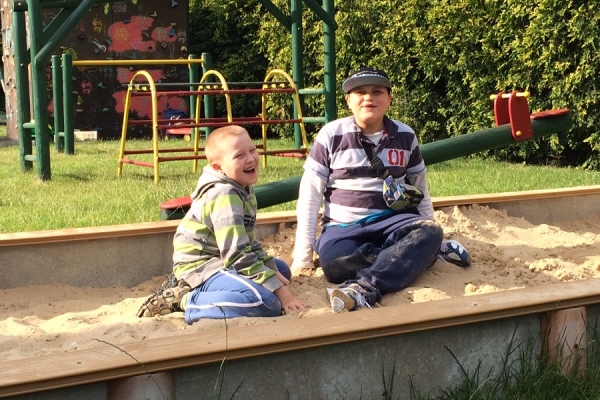
It was late in the afternoon as I sat in the sandbox with Kuba (a diminutive form of Jacob) and his younger brother Conrad. I seem to be spending a majority of my days, during this internship in Poland, in sandboxes. As the young ones were scooping sand and building roads, homes, and little towns, they were constantly chatting to me in Polish. Throughout their conversation they would periodically shout a word, "Ma?Çpa!" This is the Polish word for monkey.
The reason for this is that on the first day of my internship, in order to entertain the little ones and show a goofier side, I began imitating animals. One of them was a monkey. Since then they are constantly hounding me to do it. So as we were building our little cities I had some inspiration. I quickly cleared my city and squatted in front of them looking confused. They immediately knew what I was doing and they squealed with glee. I began to make the sounds and breathing pattern of a monkey.
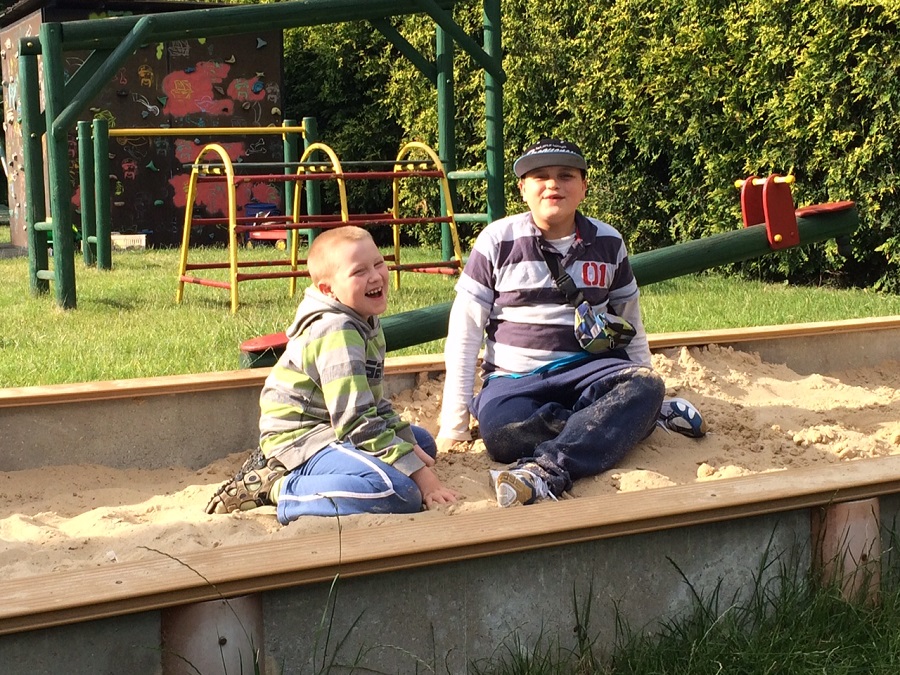 Kuba and Conrad, my English language learners.
 Slapping the sand for greater effect it was clear that I was trying to communicate with them. "Oh-HA-oh-HA-oh-HA-HA-huh-HA-HUH." They looked at each other puzzled as to what I wanted. I then found a little rock in the sand and "monkeyed" over to them so to inspect it with them.
"Kamen!" they yelled excitedly. I cocked my head to one side confused. After all, I WAS a monkey. Making a deep growl I shook my head.
"R-r-r-rock!" I said.
They repeated it, "Rock!"
I continued, "Sm-sm-small rock!"
They repeated again, "Small rock!"
"I-i-i ha-ha-have a sm-small ro-ro-rock," I concluded. They happily repeated the complete sentence.
We continued this for twenty-five minutes. I slowly began to evolve speaking more clearly, more complex sentences and even near the end we started adding and subtracting the rocks to practice simple math. What is even more wonderful is that we did this mostly in English. They were enjoying my acting like a monkey as I enjoyed listening to them speak a language they thought they could not speak.
I can see a beautiful lesson in this unfolding interaction. When in a new setting, especially one where the language is extremely different, it is important to see yourself as an evolving human being. The frustration of language will consume you if you don't. It is very easy to put high expectations on yourself to learn, memorize, and succeed - to dominate knowledge. However, ironically and humorously, in order to go far beyond the mundane toils of linguistics and supposed process of intelligence, it might help to take a few steps back. When we don't give ourselves these expectations, we are able to rejoice in small victories. We are able to communicate and actually grow in sophistication. Out of nonsense, howls and sand slaps I was able to teach sentences, communication skills, and even mathematics. I would say that is quite a victory and I know fully well that I will continue to evolve.
HELP US INCREASE OUR REACH. PLEASE SHARE THIS POST ON SOCIAL MEDIA!